

Hungarian Spring: Orbán's departure is great news (but it might not mean what you want it to)
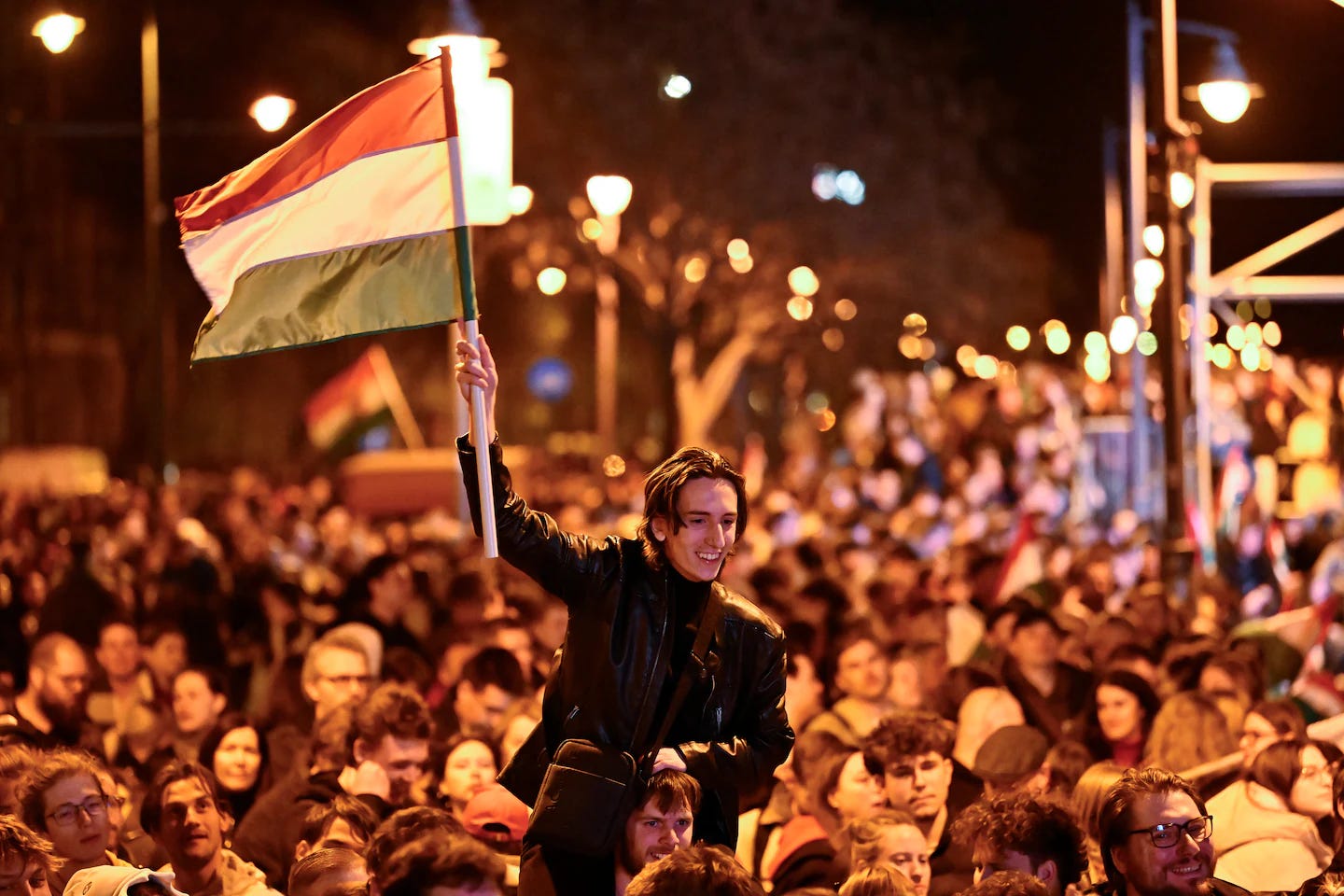
Hungarians are celebrating what once seemed impossible: The removal of a deeply corrupt strongman. Voters voted; democracy worked. But don’t go thinking this is the start of a liberal wave….

“Just wait,” said my father, an uncharacteristically hard edge to his voice.
“There’s going to be 15 years of hope and expansion, and then it’s going to go right back to how it was…only worse.”
It was the fall of ’96, a bittersweet farewell trip to Budapest. Everything was beginning for Hungary, it seemed, even as it was ending for him. My father had just a few months to live, and he knew it. But despite the grim October rains, Budapest was aglow. It was still the hopeful first years after the Wall had fallen, and the streets and cafes were bursting with new life.
Not all of these lifeforms boded well. One afternoon at a coffeehouse, my cousin—with extreme caution—pointed out the Russian mobsters a few tables away, their hard faces set in scowls. Even at a distance, I found them utterly terrifying. Still: Money was flowing into the country, and with it opportunities beyond most Hungarians’ wildest dreams. What could go wrong?
On my second trip to Hungary, nearly 25 years later, I found out. As I walked the dirty subway platforms and waited in comically long supermarket checkouts, I searched peoples’ faces for kindness, but found it lacking. Hard-eyed men and women, their faces reddened by sun and alcohol, smoked and coughed and glared. At tram stops, stooped elderly people fished items out of trash bins. Still, I was halfway through my month-long trip before I finally admitted how grateful I was not to have been born here.
Though I don’t speak Hungarian, I can get by. And in that special way that happens when you’re just passing through, I found myself going deep with strangers, and I was struck by what they told me. Every one of them—from those in the professional and intellectual classes down to Roma taxi drivers and cafeteria workers—said more or less the exact same thing:
If it were easy to do, and there were no consequences for my family, I would leave here tomorrow.
Welcome to Viktor Orbán’s Hungary.
The “Smart Donald Trump”
Now that he’s been voted out, there’s not much point in sharing Viktor Orbán’s backstory. But he deserves just a bit of ink, if for no other reason that he’s often described as resembling an abler version of our current president.
At the risk of using complex political jargon, Orbán sucked. A naked populist, he rose to power on a platform of old-style nationalism, strict immigration controls, and “traditional” (meaning anti-LGBTQ+ and antisemitic) values. Like Trump, he served a single term as prime minister (1998 - 2002) before returning to office emboldened and having greatly consolidated his power, in 2010.
How did he do it? The same way it’s being done here: By rewriting parliamentary laws, eliminating media outlets not under state control, and forcing the retirement of senior judges and restructuring the judiciary to favor his party, Fidesz. And he did it, like Trump, by invoking symbols of the past—even when those symbols hearkened back to a not-very-rosy time. During my 2019 visit I was struck by this nakedly Socialist-style poster plastered on a Budapest side street.
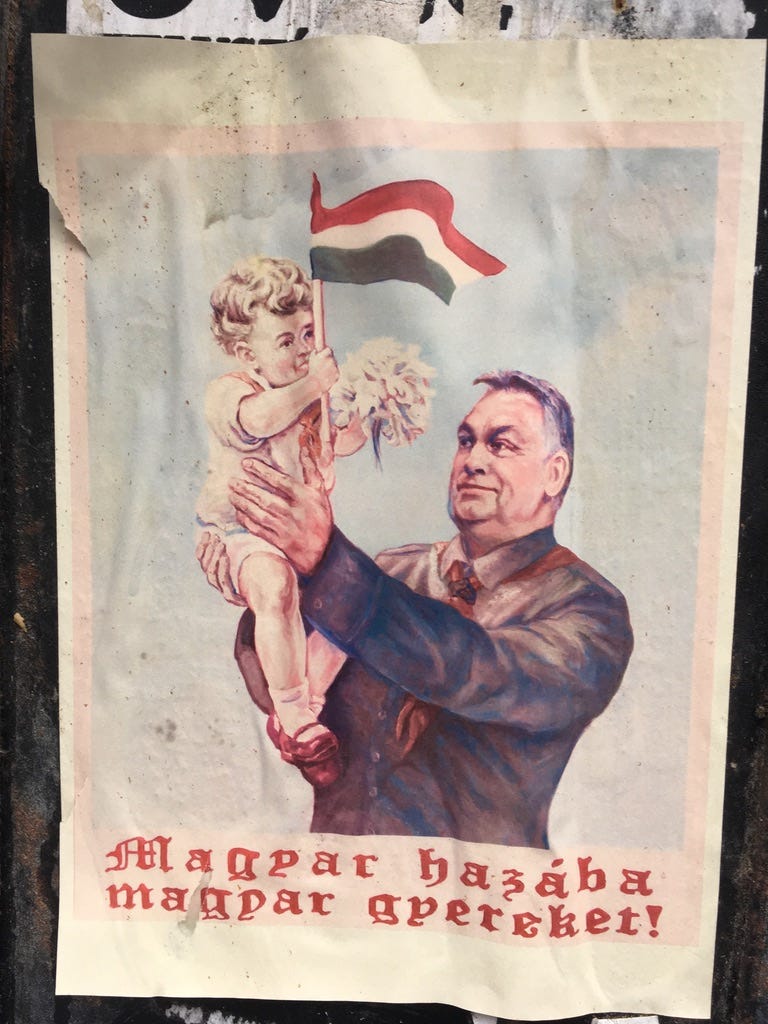
Why would you want to turn back the clock to the old days? Simple: Because they’re actually better than the present. Indeed, some friends who’d lived through the Socialist era describe the Orbán years as being even worse. Under his leadership, ordinary Hungarians grew markedly poorer; in 2025 the country officially reached the bottom of EU nations in per capita income, even as Orbán and his family grew preposterously wealthy. That year, a drone captured footage of a herd of zebras near the prime minister’s 30 million Euro compound. (No word on whether Orbán pets, eats, or merely hunts them.)
A Challenger, Not an Upstart
In the runup to last Sunday’s vote, anxiety was high. Between the possibility of state-sanctioned violence, a last-minute declaration of a state of emergency or a simple refusal to accept the results, everyone was on edge. There was also the very real threat of a false flag operation; in March, the Washington Post reported that Russian intelligence had proposed just such a plan (called “The Gamechanger”) involving a fake assassination attempt against Orbán.
In the event, the election was kind of anticlimactic. The people—roughly 80% of them—voted, and when it was all over, Orbán’s Fidesz party held just 55 seats in parliament as opposed to 138 under challenger Péter Magyar’s Tisza party. The biggest surprise was how easily—dare I say gracefully?—Orbán conceded defeat. This is unequivocally great news, and it should be cause for hope. But at the risk of dampening anyone’s spirits, let’s be clear: This isn’t the start of a liberal upsurge for Hungary.
Who is Péter Magyar? Let’s start with what he’s not: a dark horse challenger. Nor is he anything like an establishment Democrat in this country. The fledgling party he currently leads, Tisza, is right-leaning and populist. He is not the Hungarian Kamala, Bernie, or Pete B.
Fun fact: The name “Magyar” means “Hungarian,” so “Péter Magyar” is slightly akin to having an American president named “Dick American.”
Magyar joined Tisza in 2020. Before that he was a Fidesz insider; his ex-wife, Judit Varga, served as Orbán’s justice minister. The two separated in particularly ugly fashion after Magyar accused her of participating in a cover-up of sexual abuse at a home for foster children. Varga responded with allegations that Magyar had engaged in long-term physical and psychological torment.
Marital issues aside, Magyar claims he quit Fidesz because of the spectacular level of corruption. Imagine if a high-minded member of the Trump cabinet—come on, think of one!—broke ranks not because of the Constitution-subverting or race-baiting or human rights-violating aspects of this administration, but because they were sick of the naked graft and self-dealing. I mean hooray for them, but…is this really the best we can ask for?
Apparently, it is. It’s not so much that Hungarians disapproved of Orbán’s policies; they were sick of being ripped off. It’s tempting to frame this election as a referendum on authoritarianism, but that’d be a mistake. In a country in which a journalist who tripped and kicked refugees (notably a father holding his young son, and a little girl) became a sort of folk hero, Magyar is staunchly center-right, and doesn’t appear very interested in opening Hungary’s borders or expanding the protections for LGBTQ+ and other groups that were so deeply eroded under Orbán’s tenure.
Good News for Ukraine
Here’s one thing to celebrate: The removal of Viktor Orbán is unequivocally positive for Hungary’s neighbor, Ukraine. Like Donald Trump, Orbán fawned over Putin, telling the Russian leader in an October phone call:
“Yesterday our friendship rose to such a high level that I can help in any way. In any matter where I can be of assistance, I am at your service.”
Sidebar: What exactly happened “yesterday?” A manatee orgy? A festive meal of zebra tartare?
I digress. In practical terms, the major way Orbán helped Putin was through obstructionism. As a member of the EU, Hungary used its veto power to stymie any moves to help Ukraine. According to The Guardian, more than 40% of all publicly reported vetoes (including that of a 90 billion Euro aid package to Ukraine) were initiated by Hungary.
But Hungarians, mindful of their country’s long history of serving as a welcome mat for foreign armies, didn’t take kindly to such puppeteering. They’d had enough of it, and as Heather Delaney Reese recently wrote here on Substack, not even the full weight of the American government’s endorsement was enough to sway Hungary’s voters.
The Land My Father Dreamt Of
Right now, I’m feeling a lot of emotion on behalf of my friends and family in Hungary. The sense of a great weight being lifted is palpable, and I truly hope that ordinary Hungarians will enjoy some of the opportunities they’ve so long hoped for, but also freedom from want—the kind that might erode the desire for strongmen like Orbán in the first place.
Of course, I’m thinking of my father, too. He seems more and more like what he actually was: a figure from another era. He was an unabashed believer in America’s promise, in ways that sometimes made me a bit squeamish. But that was his right: He’d fled the crushing dread of Socialist Hungary for a shot at liberty and prosperity, and it pretty much panned out for him. But while he predicted Hungary’s timeline with impressive accuracy, I doubt he could’ve foreseen what’s become of the United States he so loved. It pains me to say it, but I’m glad he’s not around to see it for himself.
Hungary isn’t America, of course, and it’s wishful thinking to project our own symbols onto another nation’s tapestry. But right now, I can’t help but hope that a little bit of what happened there might rub off on us, too.