

Start Here: A 9-Year-Old’s Take on Punk Rock
50 years ago today, on Feb. 12, 1976—coincidentally my 5th birthday!—the Sex Pistols played the Marquee Club. To celebrate, here's an excerpt from my book-in-progress, on my introduction to punk....

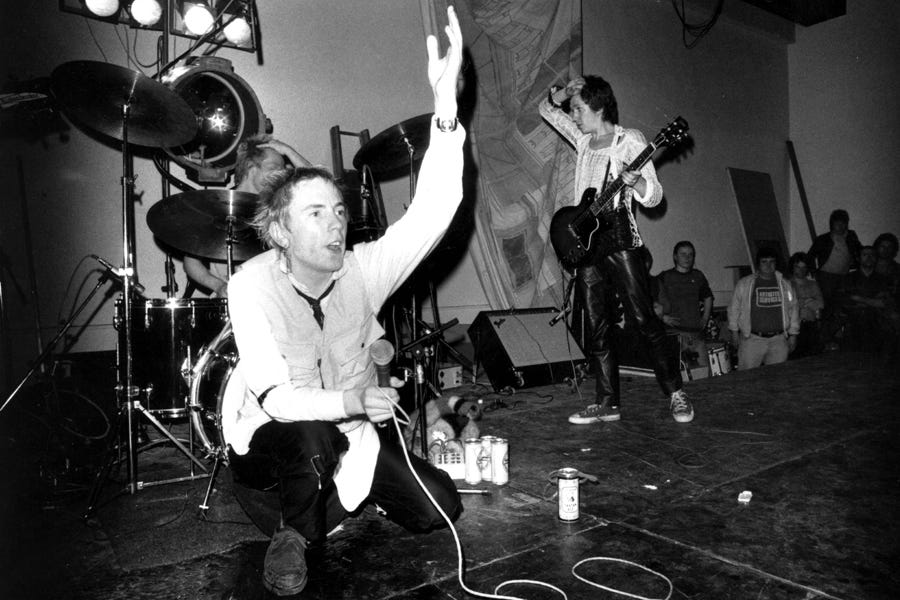
“There’s this new band,” said Byron. “It’s two guys and two girls. They wear leather and they’re really nasty. Sometimes the guys have sex with the girls on stage. Then the girls have sex with their microphones.”
We were out by the jungle gym, the one I came to on days I wasn’t picked for softball or four square, which was literally every day. No one else was around. It was a Friday afternoon in 1980, and we were in third grade.
I didn’t know whether to believe him or not. That was the thing: One minute you could be in on the joke, the next you were the joke. Byron’s brown eyes were mischievous and quick; with his button nose and curly hair, they gave him the look of a slightly malicious leprechaun. Like me he was nine but he seemed far older. His parents had split up when he was really young; a few years later his mother, gravely ill with cancer, would die on the operating table during a last-ditch experimental treatment.
And so he took it out on the rest of us. Even the teachers seemed a little afraid of him; he could bring class to a grinding halt with just a few choice words. When he turned his scorn on me, which was often, my stomach would just kind of shrivel up. I suppose he hung out with me so he could feel like he wasn’t the most wretched person in our class. And I took it because I didn’t really have a choice.
It used to be different. I’d had a real friend, once: Tim. Tim and I met in 1974 at the little Montessori daycare off MacArthur Boulevard. We were different—my hair bushy and brown, his blond and straight, cut in a perfectly bowl-like Prince Valiant—but also the same: outsiders, shy and self-contained. We fell in together like puppies. Even then we shared a fascination with music, poring over the stiff cardboard jackets of Revolver and Sgt. Pepper’s, The Birds, the Bees & the Monkees like scripture. The rifts and valleys etched into the vinyl were imbued with traces of their creators’ souls—we were certain of it. But that was a lifetime ago. For some reason that was never made clear, he just stopped coming over. Now I could barely remember him. And so I was stuck with Byron instead.
I did have one other friend, sort of: The Toshiba clock radio by my bed. It was a sleek piece of ‘70s high design, that radio; all sleek plastic and plexiglass. Every night I’d twist the knurled tuning knob, probing the airwaves for signs of life. Sometimes, at the far end of the dial, I’d hear the ghostly traces of low-power stations hidden in woolly swaths of noise: Secret broadcasts, embedded in the air but only perceptible to those who knew where to look.
I heard all kinds of music coming through that radio—disco, gospel, all-day banjo jams on NPR—but it was rock and roll that called out to me. Not just any rock and roll, either. I didn’t really know what “I Can’t Explain” or “All Day and All of the Night” were about, but it was these songs—not “Hotel California“ or “Stairway to Heaven” or any of the other fist-pumping hits—that leapt from the Toshiba’s single speaker, nailing me to the spot.
I didn’t understand the mechanics of sound, how an electric guitar could drive an amplifier to the edge of feedback and then beyond, how way magnetic recording tape could compress the music and make it sound like syrup. All I knew was that these songs were pushing on a membrane deep inside me, the thing that kept me separate from the world outside. This music, beaming not just through space but seemingly through time, felt like proof of life. They were a beacon guiding me to something—anything—better than this.
Now, as Byron told me about this vile band with their lewd gyrations and filthy lyrics, a crystal-clear image formed in my mind: An alter-ego ABBA, all dressed in black patent leather, cracking bullwhips to some malignant beat. Though they were far away in Sweden or New York or somewhere, what I felt in that moment was a physical sense of threat. And yet I was spellbound. I had to know more.
“W…what’s their name?” I said.
Now Byron’s elfin features creased into a smirk; the hook had set. “The band,” he said, “is called the Sex Pistols.”
Love this 😂
My impression of the sex pistols was always that they were pure spectacle, though that's coming from someone born decades after they broke up. reading about the playground mythologising lives up to that, though. I recently finished writing about punk and honestly tried to avoid them entirely; they have a gravitational pull that makes it hard to write about anything else.