

We Got That Supertouch
Blink and you'd have missed it. But forty-four years ago, with little to no fanfare, Bad Brains’ “yellow tape” dropped. Punk, hardcore, and metal would never be the same again.

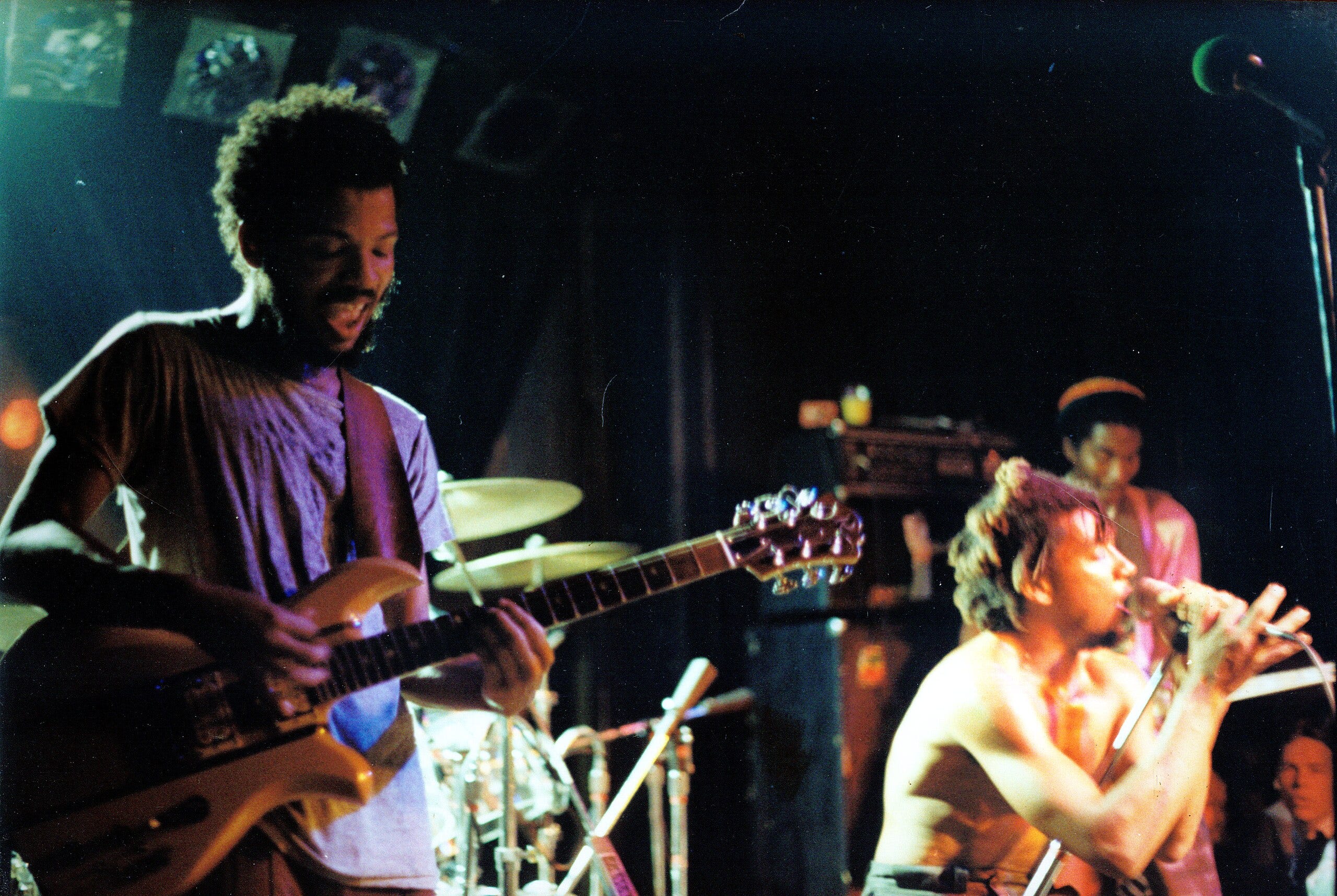
Returning to the place you’re from can do funny things to your head.
Washington, D.C. feels different than it used to; sometimes, it’s hard to orient myself. But certain spots—nondescript streetcorners, random alleyways—have a way of bringing me back in time. Not long ago, as I rolled down 35th St. NW, I realized this was the exact spot I first heard Bad Brains blasting from the cassette deck in my friend’s mom’s Suburu.
As the music cauterized my eardrums I felt I’d been let into some arcane knowledge, a secret handshake. I was 16—the sweet spot for the so-called “reminiscence bump,” when identity and music weld together—and I’d never heard anything like it before. What I felt, in fact, was disbelief. How could ordinary human beings have played music this feral and kinetic?
I wasn’t a hardcore kid, had little use for the dime-a-dozen paddle-thrashers and their 8-band matinees. What I was hearing was infinitely more nuanced, and rife with contradictions. How could it sound so explosive, yet tightly controlled? Why did it sound caustic but also grounded? Under the searing guitar, the bass channeled Lemmy’s ferocious clank, only with far greater finesse. The drummer was, possibly, superhuman: even at this blistering pace, the music swung and swaggered. And of course there was that voice: Growling, screaming, and crooning, so eerily self-possessed it verged on the messianic (more on that in a moment).
It’s been written before but it bears repeating: Music—rock music, especially—is its sound. And this format—the cassette tape—was the perfect delivery system for the Bad Brains’ sonic attack. As I’ve written about another classic hardcore album, the cassette is the punk format. Here its technical limitations—compression to the point of saturation, treble-heaviness, ample harmonic distortion—become assets.
What I was hearing was a blueprint, one of those single recordings that define an entire genre. I’m talking, of course, about the Bad Brains’ ROIR tape—aka “the yellow tape”—released on February 5th, 1982.
“Once you conquer one place you move on to the next.”
The Bad Brains’ story is long and convoluted; some 50 years after the band first formed—as a Return to Forever-styled jazz-fusion outfit called Mind Power—they still stage sporadic concerts. The band has full-on broken up several times, or merely parted ways with and then reunited with singer H.R. (nee Paul Hudson). But no one in Bad Brains is replaceable, even when they don a motorcycle helmet and refuse to sing (H.R.’s mental health struggles are well-covered elsewhere).

But in 1982, Bad Brains were ascendant. They’d recently relocated to New York from D.C., a move that was—according to bassist Daryl Jenifer—spurred by a gig at the Childe Harold, a Dupont Circle saloon. After Bad Brains’ performance, the owner—distraught by damage to the club—swore: “I’m not having no more punk rock here—especially no black punks!” In a 2025 podcast interview, Jenifer says:
“Once you conquer one place you move on to the next…there was no stopping or banning Bad Brains during this time; what you hear is the Bad Brains saying ‘Oh you banning us?’ We’re the ones writing “Banned in D.C.” We’re “Banned in D.C.” so now we’re going to New York. And after we go to New York we’re going everywhere. It’s avoiding the hometown hero shit, ultra-talented people who never left.”
Self-mythologizing? Sure. But of all the early American punk bands, Bad Brains arguably have the right. Taking as much from Mahavishnu Orchestra as from the Damned, the band created a musical identity from a wildly disparate set of inspirations. Jenifer again, quoted in a 2007 interview:
“I remember thinking “Sweet Home Alabama” was a motherfuckin’ heavy metal song. When I heard that I thought it was the heaviest shit ever. A lotta black rock brothers might have a Hendrix influence; our riffs are closer to Sabbath and the Ramones.”
But creating a unique sound and documenting it are very different propositions. Listen to the band’s early demos (Black Dots and Omega, both given proper releases in the late ‘90s) and you hear a band still finding their way. Their inspirations are clearly present—“Redbone in the City,” from Black Dots, is a comically direct lift of “God Save the Queen.” You can see the seams; the sound is spastic and clanking, a thrashing electrical current with no path to ground.
Even then the band were ramping up the tempos and sharpening their attack, but the only recording they’d seen fit to release was the “Pay to Cum” single, in June of 1980. Despite the song’s fierceness and originality—the scatty vocal, riding atop a blistering guitar-and-drum assault, is a nod to jazz fusioneer George Duke—the record, with only 800 copies packaged in hand-folded paper sleeves, was never going to make a massive impact.
That is, until the band found Studio 171A.
The Sounds (and Smells) of a Punk Squat
171A was the brainchild of Jerry Williams, a North Carolina transplant who’d come to the city with his band Th’ Cigaretz—“Raleigh’s first punk band”—in 1979. The group never made a huge splash, leaving only the Crawl Rite Outta My Skin LP in their wake. But Williams had bigger plans: Embedding in the Lower East Side, he began renovating a former glass shop at 171 Avenue A with an eye towards making it a venue. To that end, he constructed a stage at the front of the room and an audio booth at the back.
But 171A’s run as a venue would be short-lived. After pulling off gigs for a few weeks in late 1980, a rival club, irked that the venue was selling liquor without a license, tipped off the Fire Department. Plan B was a pivot, transforming the room into a rehearsal space. Jerry Williams, who died in 2010, described the main room:
“[It was] a full-sized room with 15 foot ceilings and a floor space 60 feet long...with a quality PA system suspended from the ceiling. It was a cut above other rehearsal studios, and since it was about half the size of CBGB’s, it produced a very similar sound.”
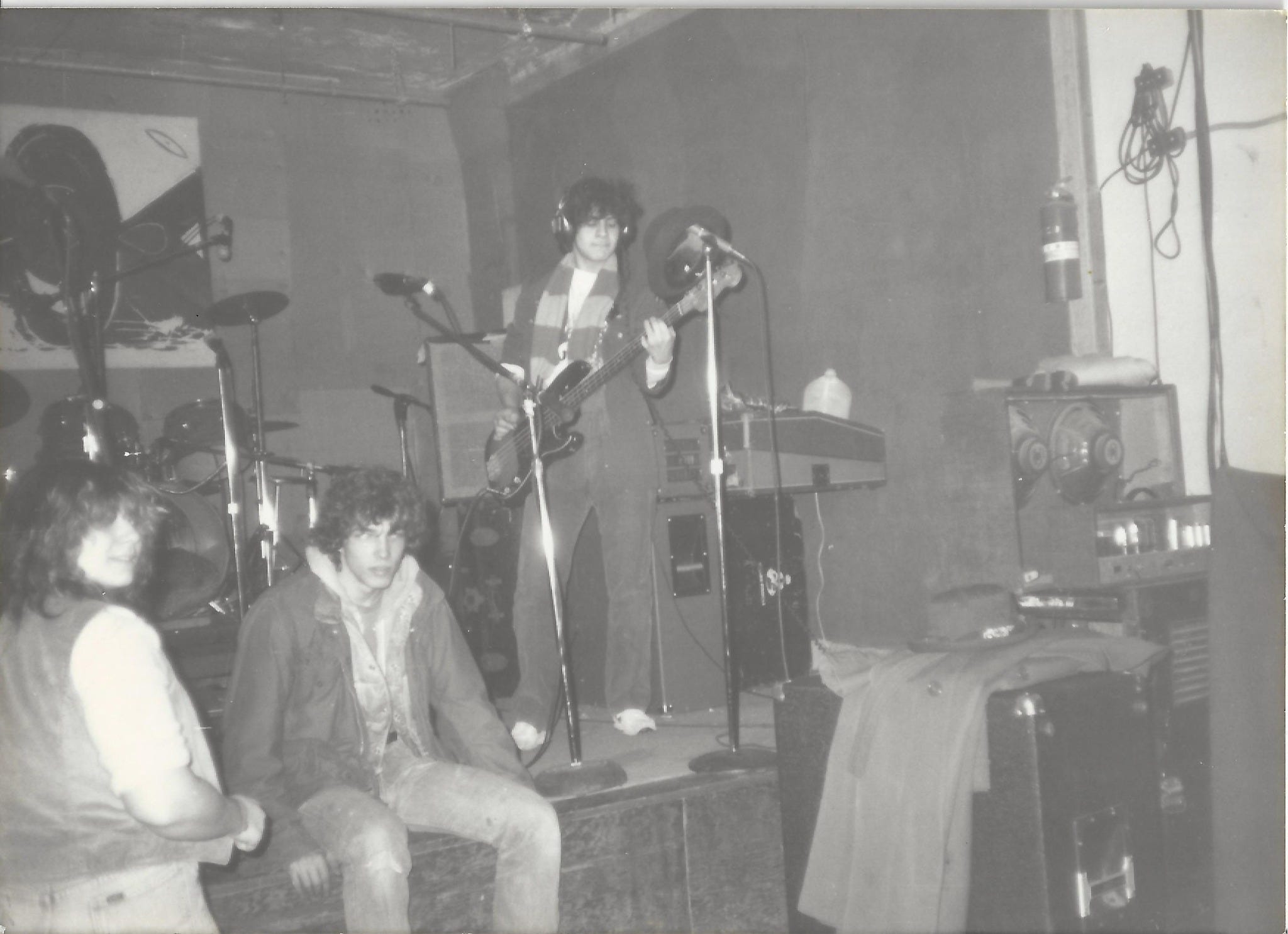
Sadly, there are few photos of the space online; this one depicts the NYC band The Mob (not to be confused with the archetypal UK anarcho-punks of “Witch Hunt” fame) recording at 171A:
Bad Brains guitarist Dr. Know—nee Gary Miller—picks up the story:
“We tried to hang in New York for a minute and that shit beat us down. We came home to D.C. for a couple months, and the Spirit said, “Yo, you gotta go back up there. Come on!” That’s when the 171A thing came in, in 1982.
There were no windows in that place—it wasn’t a real studio, it was a squat that Jerry created. I remember the little stage there, and Jerry built a control room out of the lighting booth. You’d have to crouch down to go in. I was living there, under the booth. Me and Jerry Williams used to stay up ’til 6am every morning. It was our space. We’d come in and rehearse and write songs, and we had the luxury of being able to document it.”
The Fallout
“Luxury” isn’t the first word that comes to mind when envisioning 171A. Though I never visited the place myself, I did enough time in punk squats that the sense memories—the aromas of decaying carpeting, sour beer cans, and terrifyingly soiled toilets—will live rent-free in my head for perpetuity.
But the dodgy surroundings aside, the recordings that were captured here—in sessions between August and October of 1981, plus a live set taped in May of that year—remain one of the essential documents of American hardcore. And while reggae songs performed by non-reggae artists generally bore me to tears, the Bad Brains never bettered the performances included here.
Released on ROIR—aka Reachout International Records, a still-extant label dedicated primarily to cassettes—that yellow tape became a totem and a calling card. And after years of struggle, and reinvention, it should’ve been the kickoff of a triumphant career.
Of course, things didn’t quite work out that way. This isn’t an article about all the questionable behaviors the Bad Brains are alleged to have engaged in—trust me, it’d be a long one. But from alienating and insulting their supporters to committing extortion and even, according to one sworn eyewitness, threatening club staff and bystanders with a pistol, they suggest a disturbing pattern. Having infused hardcore with messianic overtones, perhaps the band came to believe their own legend. Even as they’d reach greater artistic heights with their 1986 album I Against I—is there a Living Colour, a Faith No More, a Red Hot Chili Peppers or even a Nirvana without it?—the Bad Brains were often as not their own worst enemies.
But maybe that’s the point of punk: To be the brief candle, to make a big noise and then fade away. Forty-four years ago, that’s precisely what the Bad Brains did. The music encoded on that yellow tape seemingly does the impossible, seemingly breaking the bounds of physics to take flight. Today, we’re still hearing its echoes.
A friend put "Let Me Help" on a mixed tape for me and it blew me away. Nothing else like it.
The ROIR cassette never really did it for me. I was getting into HC/Punk in the late 80's and "i against i"was what hooked me as it did everyone who skated/rode BMX back then. It was haunting and crazy and was a great stepping stone from the Minor Threat records to my ears to the next sounds.
Then sadly (as you mentioned) they went too deep into Rasta's homophobia and alienated people like me who never really gave a damn about them after BNB.